Editorial · Illustration
The Tale of Takshashila.
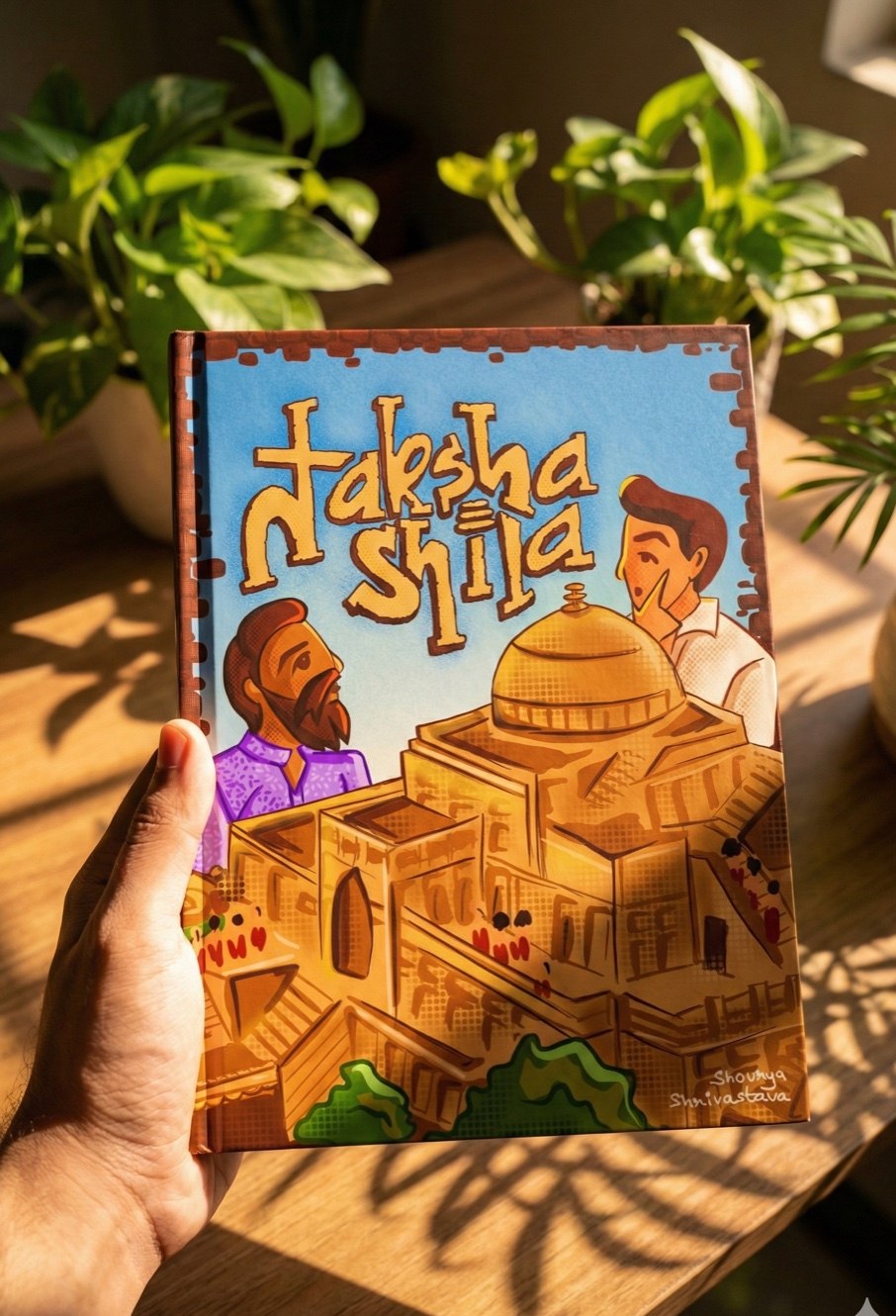
A digital graphic novel that walks the world's first university. I reimagined Takshashila as a quiet dialogue between a curious Traveler and a Mysterious Guide — an "Indigenous Modern" book that carries an intangible heritage into a contemporary reader's hands. It remains my most-appreciated personal project.
The premise
Takshashila — Taxila — is remembered as the world's first university: a place where scholars, thinkers and seekers of truth gathered from far and wide, more than two thousand years ago. Today it survives only as scattered stones and half-buried pillars in present-day Pakistan. The history is extraordinary, and to most readers it is almost entirely invisible — a footnote, not a place you can picture.
I wanted to make that heritage walkable again. Not a textbook, not a documentary — a digital graphic novel you move through, where the ruins slowly fill back in with the life they once held. The premise let me work the way I most want to as an illustrator: turning a body of classical Indian visual culture into a story a contemporary reader actually wants to follow.
A story told as a dialogue
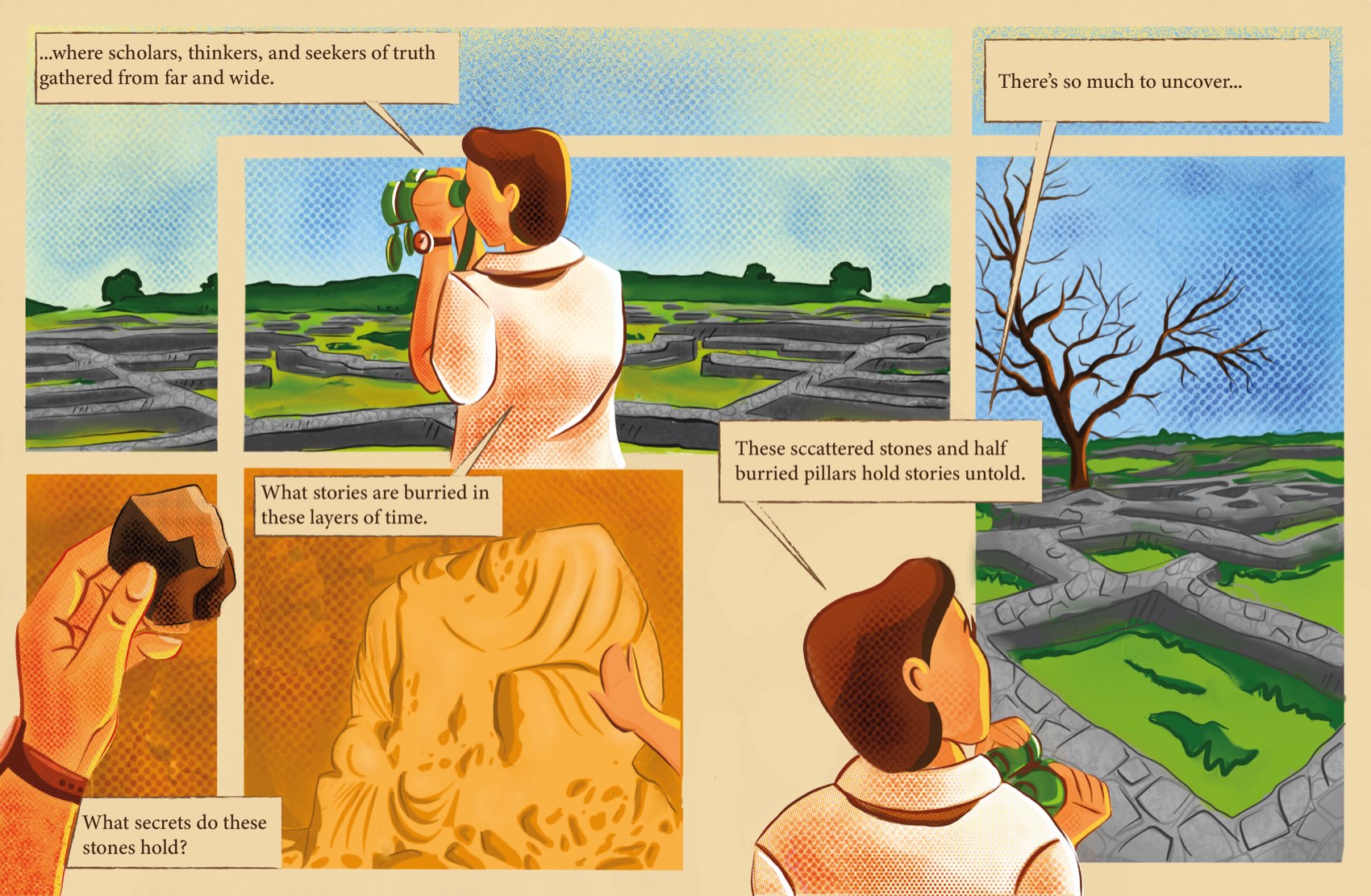
I built the narrative as a conversation between two characters. A young Traveler arrives at the archaeological site with binoculars and questions; a Mysterious Guide appears to answer them — and the present-day rubble dissolves, page by page, back into the living city.
The dialogue does the heavy lifting. It lets a reader stand inside the ruins, ask the obvious human question — what stories are buried here? — and have the past answer directly. No lectures, no dense exposition. Just one curious person being shown around by someone who remembers.
The two characters
The whole novel rests on a pair of figures I designed to be opposites — and each got a full turnaround before any page was drawn.
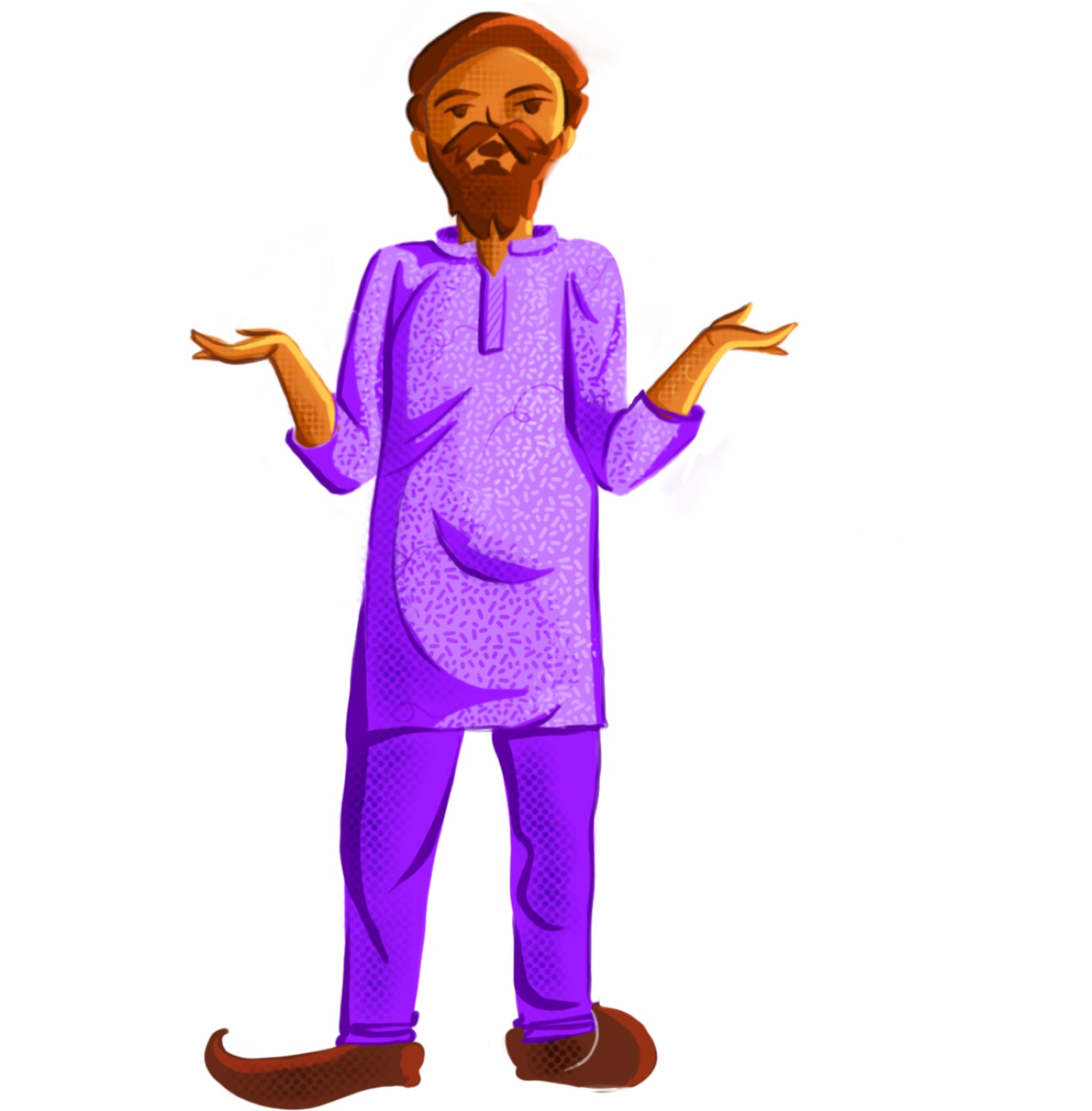
- The Mysterious Guide — an older, bearded man in a purple-lavender kurta-pyjama and jootis, hands open in a perpetual "let me explain" gesture. He carries the deep time of the place.
- The Traveler — a younger man in a white floral shirt, teal shorts and white sneakers, binoculars around his neck, hand on chin. He is unmistakably modern: our eyes inside the story.
Holding one foot in the present and one in the past is the engine of the book, so I let the costume design carry that contrast on its own. You can read the two-thousand-year gap between them before either says a word.

These scattered stones and half-buried pillars hold stories untold.
Then and now
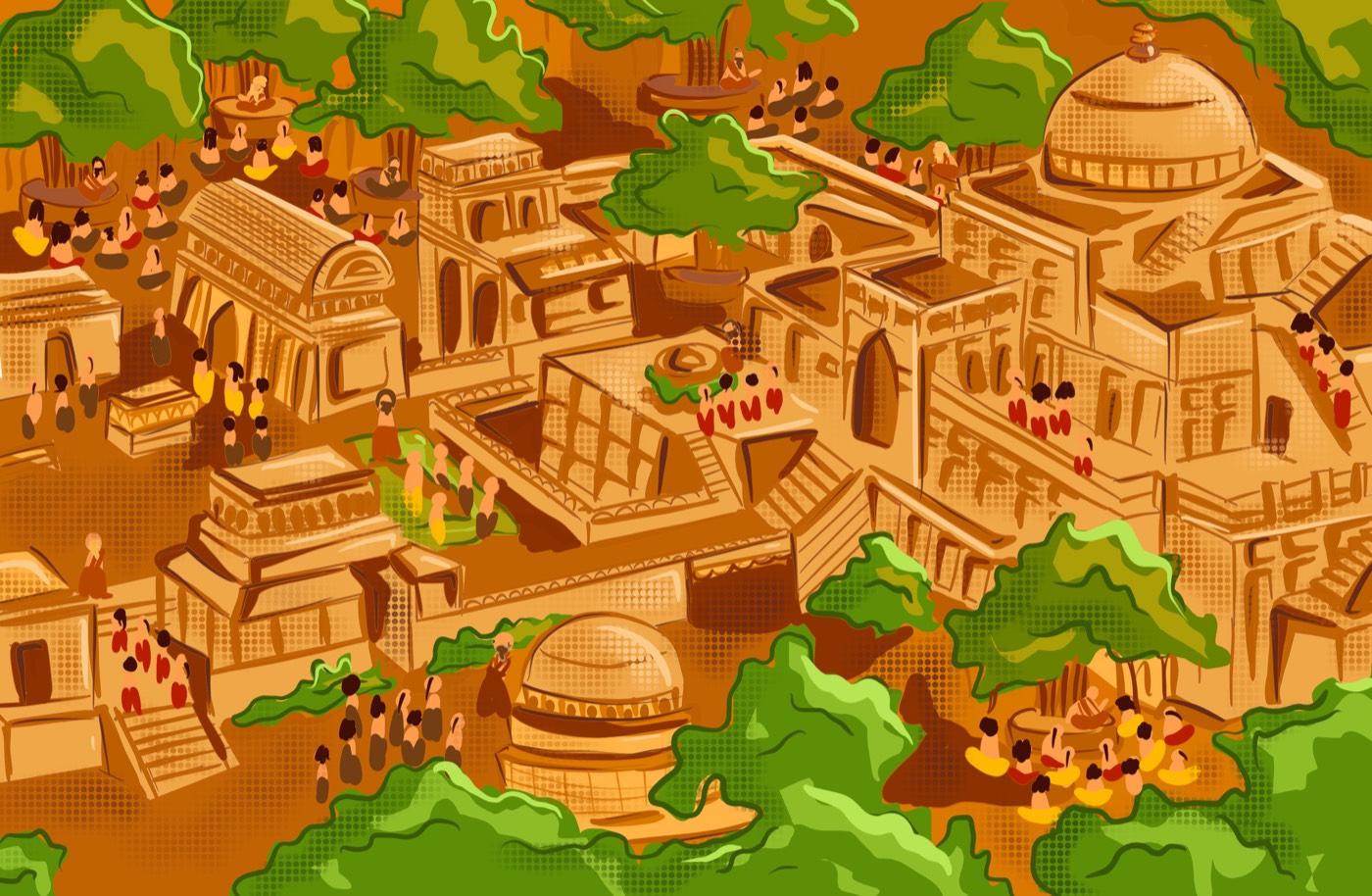
The emotional spine of the book is a single pair of images. The banner above shows Takshashila at its height — an isometric aerial of stupas, lecture halls and terraces, alive with hundreds of tiny robed figures in yellow and red over a halftone-dotted ground. I drew it teeming on purpose: you should feel the crowd before you read a single caption.
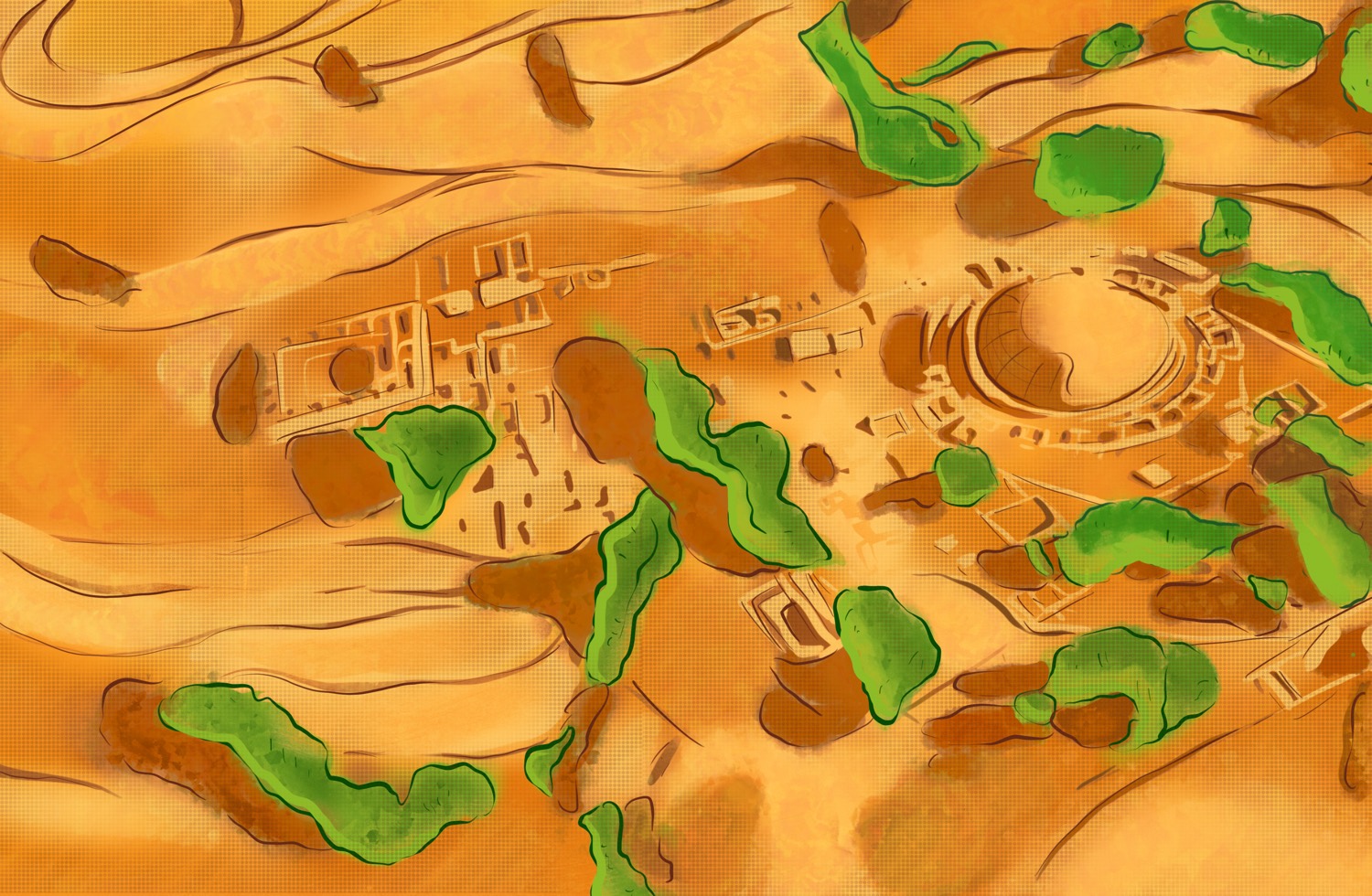
Then I drew the same footprint again as what survives today — broken foundations and stumps of wall in bleached sandstone, vegetation creeping back in. Laid side by side, the two aerials are the whole argument of the project in one glance: how much was here, and how little is left.
Building the world in panels
Each of the Guide's answers opens out into a whole era of Takshashila. I paced the sequential pages to move from scholarship to destruction to science: a saffron-clad scholar teaching two students; a chariot battle with a temple burning behind it; an astronomer pointing into a starry, violet cosmos. Three panels, three centuries.
Smaller panels carry the texture of daily life — hands rolling dice with red powder, students bent over potters' wheels, a guru's hand giving alms — while map spreads ground the story geographically, locating Taxila within the ancient mahajanapada of Gandhara, its rivers and neighbours labelled for the reader. The big set-pieces give the awe; the small panels give the proof that real people lived here.
An "Indigenous Modern" language
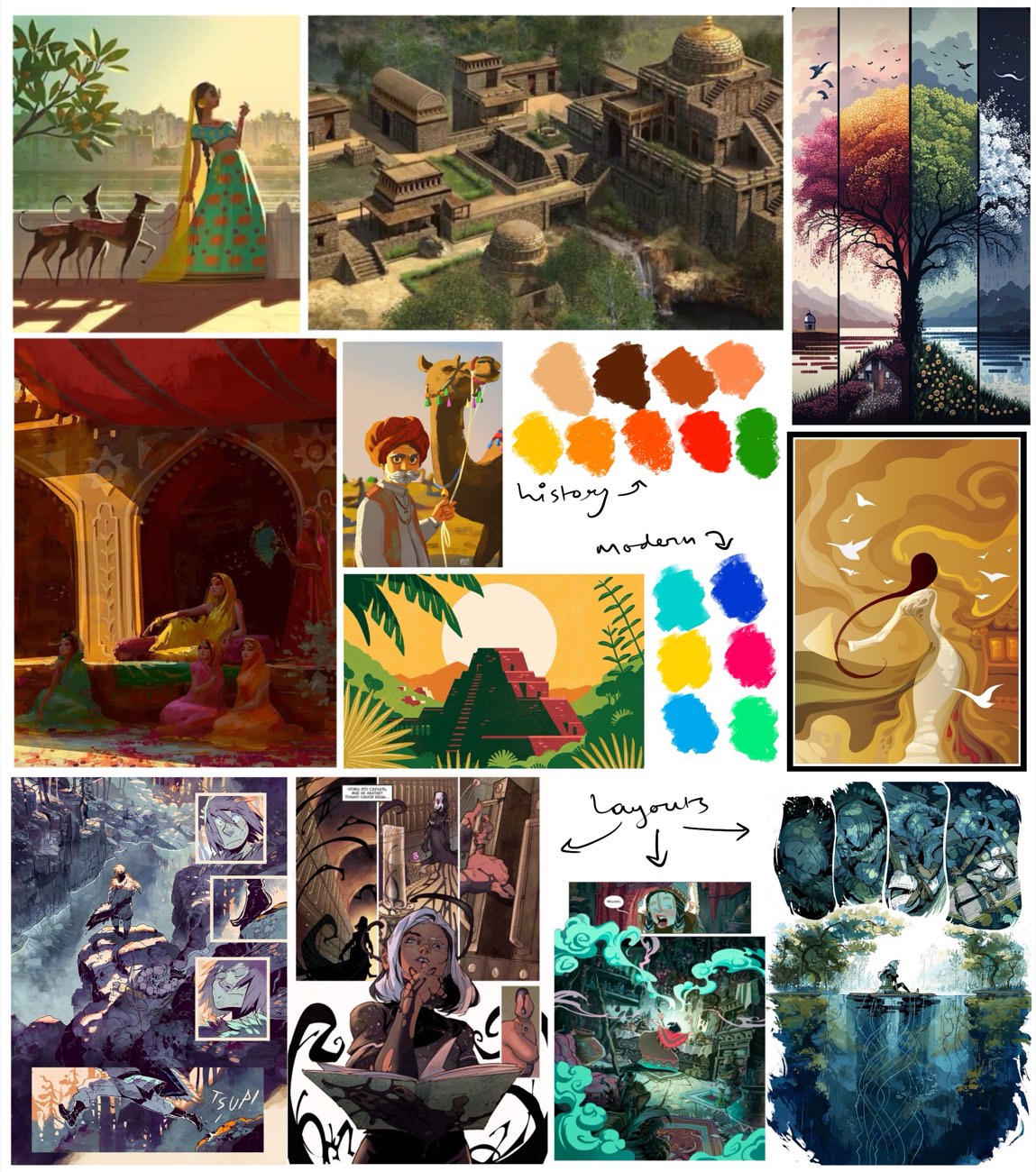
The visual brief I set myself was Indigenous Modern — classical Indian visual culture reimagined in a contemporary graphic-novel language, an earthy classical palette carried in a confident digital hand. It's the through-line of my personal work, and Takshashila is where I pushed it furthest. History scenes lean into warm earth tones; the modern frame and the cosmos sequences pull toward bright, CMY-style accents, so the reader can feel which time they're standing in without being told.
It started on a moodboard: collected references for poses, architecture and seasonal trees, with palettes annotated by hand — history → warm earth, modern → brights — and arrows mapping how each would be used. From there I held one rule for the whole book: detailed character linework set against expansive, atmospheric panels.
Tools & process
I drew the book over 25+ weeks. Every page was illustrated in Procreate — from construction sketch through line to final colour — with the wordmark, title lettering and map typography refined in Adobe Illustrator. The "Taksha=Shila" logo went through its own development, from a dense halftone-textured treatment to the cleaner cream-on-black mark that crowns the cover. The training that taught me to sit with that kind of detail came from my BVA in Applied Arts at MSU Baroda, where I graduated a double gold medalist.
The result is a single, self-contained piece of cultural storytelling — a place most people will never visit, rebuilt page by page so it can be read, walked and remembered. It's the project people return to most in my portfolio, and the clearest answer to what "Indigenous Modern" looks like when it's given room to be a whole world.